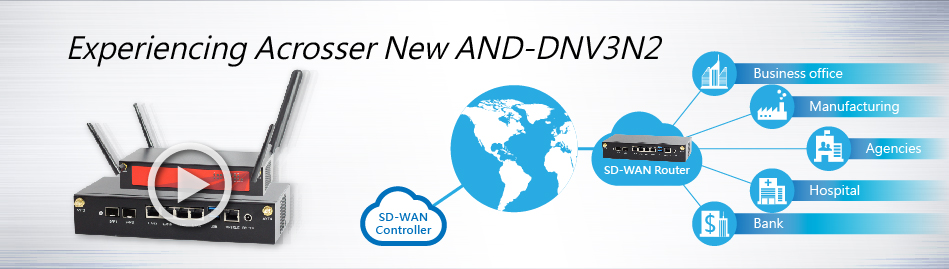
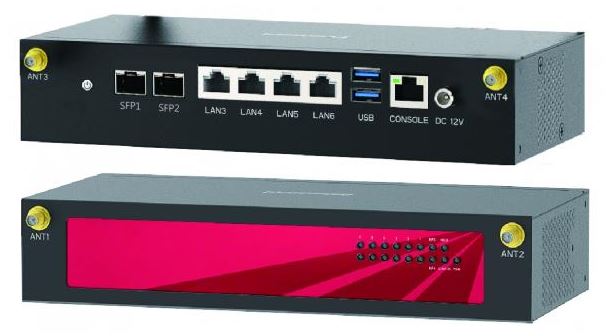
ACROSSER Technology latest network appliance, AND-DNV3N2, which equipped with Intel® Atom C3558 Denverton-NS Platform and 2x SO-DIMM DDR4, 6x GbE, 2x USB 3.0, 2x Mini PCIe(One support SIM card socket),1x 2.5" SSD and TPM 2.0 for a secure cryptoprocessor. This optimized system design allows network systems to function in a small footprint and form factor. In this particular size, the AND-DNV3N2 is a great alternative for budget-conscious buyers. This cost-effective network security appliance can offer stable performance with low power consumption; and is suitable in multiple security applications including network intrusion prevention, content filtering, data leak prevention, VPN, unified threat management (UTM) and SD-WAN solutions.
Major AND-DNV3N2 Specification:
1.Intel® Atom C3558 Denverton-NS Platform
2. 4-Core SoC
3. 2x SO-DIMM DDR4
4. 6x GbE, 2x USB 3.0
5. 2x Mini PCIe, One support SIM card socket
6. 1x 2.5" SSD,
7. TPM 2.0
Acrosser had committed its valuable resources to further develop its advanced network product lines. Furthermore, Acrosser is now working directly with Intel, as part of Intel IoT Solutions Alliance, in order to be able to offer its customers first-to-market services, the latest technologies, and solutions in a timely manner. As a member of Intel IoT Solutions Alliance, Acrosser is able to directly obtain valuable resources in providing high quality and stable performance products/solutions to its customers, vis-à-vis non-IoT-Alliance-members.
Acrosser Technology Co. Ltd, a global professional industrial and embedded computer provider, announces the new Mini-ITX mainboard, AMB-D255T3, which carries the Intel dual- core 1.86GHz Atom Processor D2550. AMB-D255T3 features onboard graphics via VGA and HDMI, DDR3 SO-DIMM support, PCI slot, mSATA socket with SATA & USB signals, and ATX connector for easy power in. AMB-D255T3 also provides complete I/O such as 6 x COM ports, 6 x USB2.0 ports, 2 x GbE RJ-45 ports, and 2 x SATA port. for
more information, please visit: http://www.acrosser.com/News-Newsletter/62.html
This year, the Taiwan External Trade Development Council (TAITRA) will promote its hand-picked Taiwan Excellence Award winning products to exhibit during August 26-29, 2013 at the Moscow International Motor Show 2013(MIMS) in Expocentre, Moscow. Acrosser Technology is proud to announce that its award-winning In-Vehicle Computer, AR-V6100FL was selected by TAITRA to be showcased at the Taiwan Pavilion at this year’s MIMS.
AR-V6100FL features fanless operation with Intel Core i7-2710QE 45W CPU. Its excellent thermal design makes it a popular industry choice for In-Vehicle PCs. The efficiency of heat dissipation also contributes to its high performance under rugged automotive environments. Another fascinating feature of AR-V6100FL is its smart power management function. Acrosser built a comprehensive power management subsystem solution, allowing users to select the best setting for the power management mode to meet specific application demands.
As for the show, Moscow International Motor Show 2013(MIMS) is regarded highly in the automotive industry in Russia. Last year, the exhibitors consisted of 1,379 companies from 35 countries and 15,717 guests from 52 countries participated in this event. 99.6% of visitors were industry professionals. With its specific geographic location, MIMS is truly a trans-lateral gateway for automotive businesses. If you are looking for Acrosser’s products or other innovative automotive components from Taiwan, do not miss the Taiwan Pavilion (Pavilion 8 Hall 3, booth number: R111) this year!
AMD Embedded G-Series platform are their discrete-level graphics embedded computer capabilities.Driven by the thirst for 3D gaming in consumer electronics, current graphics processing units (GPUs) have evolved into powerful, programmable vector processors that can speed up a wide variety of software applications. These "general-purpose GPUs," as they are known, are no longer limited to the consumer market. They are making their entrance into the embedded market with the arrival of the new AMD Embedded G-Series platform.
With a total board height less than 20mm, the slim fit feature of AMB-D255T1 makes it a perfect applicationalmost everywhere. With single layer I/O ports and external +12V DC power input, AMB-D255T1 can easily be equipped even in limited spaces like digital signage, POS or thin client systems. Also, the supporting video source includes both VGA and HDMI outputs to cater to a variety of needs. Many digital signage partners have showed great interests toward AMB-D255T1 for their business sector. AMB-D255T1 has one DDR3 SO-DIMM which supports up to 4GB DDR3 memory, mSATA socket with USB signals and SIM slot, and a DC jack for easy power in. For customers that are taking their entire system to the next level, AMB-D255T1 provides one PCI slot and one Mini PCIe expansion slot with a SIM card socket for further improvement. The mini PCIe expansion allows mSATA to function together with the system or multi module choices for USB signals module installation.( mSATA storage, Wi-Fi module, or 3G/4G telecommunication)
The key features of the AMB-D255T1 include: .Intel Atom D2550 1.86GHz .1 x DDR3 SO-DIMM up to 4GB .1 x VGA .1 x HDMI .1 x 24-bit LVDS .6 x USB2.0 .4 x COM .1 x GbE (Realtek RTL8105E) .1 x PS/2 KB/MS .1 x PCI slot .1 x MiniPCIe slot for mSATA and USB device .1 x SATA with power connector .8-bit GPIO
AMB-QM77T1 is dedicated to multiple applications, such as industrial automations, kiosks, digital signages, and ATM machines. Supporting 3rd generation Intel core i processor, AMB-QM77T1 features an integrated GPU to support the following graphic libraries: DirectX11, OpenGL4.0 and OpenCL1.1. As for numbers of output, a maximum of 3 independent displays are supplied, which is a perfect solution for gaming/multimedia business. In addition, 4 USB3.0 and 2 SATA III connectors result in high data transmission.
The initial goal in creating the Raspberry Pi credit card sized, Linux-based Single Board Computer (SBC) – targeted primarily at education – was to develop a response to the decline of students engaging with computer science and related engineering disciplines. Our desire was to reverse the trend of children becoming consumers rather than creators. The following case study follows the hardware development process from an early failure, initial prototypes, and through to the finished production design.
Over recent years there has been an increasing trend for children to be consumers of digital content rather than be future creators or engineers. This trend is driven by manufacturers looking to provide a seamless experience for target customers on a variety of electronic platforms, from gaming consoles to tablets and laptop computers.
As a result, access to raw I/O has become restricted. Similarly, any packaged provision of a programming environment is an anathema to the products’ commercial goals. The knowledge required to create “hello world” or flash an external LED has become simply too vast and the opportunity to learn vital skills such as structuring/codifying ideas and debugging has been largely subsumed by a click-and-shoot world. Any motivation to get under the hood and see how these products work is largely dissipated by the impenetrable barriers presented by these “locked down” systems.
The challenge in developing the Raspberry Pi credit card sized, Linux-based SBC was to break down these barriers and provide access at a sufficiently low cost so any fear of breaking the hardware was effectively removed. Having the hardware is only half the story; the provision of a rich set of programming environments such as Scratch and Python with libraries to allow control of peripheral hardware provides an engaging toolset for learning through experimentation and play in either the formal classroom or at the many school and independent maker (hackspace) clubs. The following case study shows how Raspberry Pi was developed from the ground up.
A new starter kit for COM Express(tm) modules with AMD Embedded R-Series Accelerated Processing Unit (APU) is now available. The intelligent starter kit MSC C6-SK-A7-T6T2 contains a COM Express(tm) Type 6 baseboard, an active heat sink with fan and two DDR3 memory modules.
The intelligent starter kit MSC C6-SK-A7-T6T2 contains a COM Express™ Type 6 baseboard, an active heat sink with fan and two DDR3 memory modules. Users of the kit are free to choose one of four COM Express™ Type 6 computer modules with Embedded R-Series APU from MSC’s MSC C6C-A7 product family. Furthermore, the starter kit is also offered with a 15 inch XGA TFT display with LED backlight. Different display types or touch screen panels are available on request.
The compact baseboard with dimensions of 140 mm x 184 mm offers the module socket and numerous important connectors, above all the newly available Type 6 interfaces defined in the COM Express™ specification V2.0. The interfaces include configurable Digital Display Interfaces (DDI) which can be used via three each DisplayPort and HDMI connectors and a DVI port. In addition, four USB 3.0 ports, Ethernet, VGA, HD audio, SATA and even a PCI Express™ x4 slot also found place onboard.................
ACROSSER Technology announces our participation in 2013 the Embedded Systems
Expo and Conference (ESEC) from May 8th to the 10th. The event will
take place at the Tokyo International Exhibition Center in Tokyo, Japan.
We warmly invite all customers to come and meet us at the west hall,
booth number: WEST 10-61.
When it comes to software development, the old adage is best spun in a slightly different way: better "early" than never. Accordingly, static analysis can help those developing in Java to stay one step ahead of potential coding problems.
Today’s software development teams are under immense pressure; the market demands high-quality, secure releases at a constantly increasing pace while security threats become more and more sophisticated. Considering the high cost of product failures and security breaches, it is more important than ever to address these risks throughout the software development process. Potential problems need to be spotted early to prevent release delays or, worse, post-release failures.Fortunately, there are numerous tools to help developers manage these risks, helping to identify potential problems early in the development phase when issues are less disruptive and easier to fix. They are readily accessible to developers and easy to use within many development environments. This applies to developers programming in any language; however, we focus on Java in this discussion (see Sidebar 1).
Sidebar 1: Though Java’s mature ecosystem, numerous IDEs, and abundance of reference materials ease Java application development, they can also bestow a false sense of security upon developers, who should be watchful to mitigate Java’s weaknesses.
Static analysis helps mitigate risk
When considering static analysis tools for Java or otherwise, it is important to understand what these tools are. The term “static analysis” refers to the approach of analyzing a program without executing it. As we’ll see in the next section, static analysis tools can be used to produce reports on anything from coding standard violations to specific errors or vulnerabilities. Simply put, static analysis tools analyze source code to find information useful for managing risk.
One benefit of static analysis is that it can be performed early in the development cycle, often before the application will even execute. It is commonly integrated into an automated build, so that there is virtually no overhead to running frequent analyses. By integrating static analysis into the inner development loop, users maximize the value they get from such tools.
When used in conjunction with a well-designed development process, static analysis tools provide crucial visibility into the state of the software. This enables development teams to understand the level of risk in their code and where the risk resides so they can take action to mitigate or remove it entirely (Table 1). Individual tools generally focus on specific problems faced by software development teams, and teams often use a combination of these tools to get a comprehensive view of their development effort.
Table 1: Static analysis tools typically find specific types of issues, with each type representing a different class of risk and requiring a different type of action.
Developers have traditionally used static analysis tools via a simple IDE integration or as stand-alone tools. While the tools add significant value to the development effort, the proliferation of tools has created efficiency problems as developers spend more and more time using and maintaining different tools and sifting through more and more results. To wisely manage development resources, teams must be able to effectively manage, filter, and prioritize all those issues.
To address these problems, development testing platforms have emerged to unify and manage all of this static analysis information in one place, simplifying the user experience and increasing visibility and efficiency at larger scales while providing relevant access controls and reporting. Development testing platforms are even starting to blur the line between static analysis and other types of analysis by utilizing – during the static analysis process – artifacts generated during earlier program runs. For example, these platforms can use code coverage information from test runs during static analysis to effectively identify missing test cases automatically. The traditional approach to this problem requires significant manual effort based on simple coverage thresholds. By leveraging data from different sources, these platforms are able to significantly reduce the manual effort and time required to accomplish this with other methods.
Selecting static analysis tools for Java
The most popular, free, static analysis tools for Java are probably Checkstyle, PMD, and FindBugs. While they all fall under the “static analysis” umbrella, their strengths are so sufficiently different that many consider the tools to be complementary rather than alternatives.
Checkstyle
Checkstyle is billed as “a development tool to help programmers write Java code that adheres to a coding standard[1],” although it does not strictly limit itself to coding standard enforcement. It provides a documented API for users to define their own custom checks. Typical coding standards utilize basic rules to make code more readable and reduce the likelihood that future code changes will introduce bugs. Standards tend to define conventions about formatting (white space, bracketing, naming, commenting, and so on), inheritance, and visibility. When adequately enforced, well-designed coding standards can help developers reduce risk. Enforcement can be difficult, though, since coding standards generate a lot of violations and there can be significant pressure to ignore noisy rules. With legacy code, this can make enforcing new coding standards unfeasible. While most of the issues identified by Checkstyle do not affect code correctness, robustness, or performance, there is real value in helping developers quickly understand code written by others. It is not always obvious how to quantify the risk represented by these violations and it is problematic to measure risk directly from violation counts, but changes in those counts can be a reasonable proxy for changes in risk.
PMD
PMD is described as “…a source code analyzer. It finds unused variables, empty catch blocks, unnecessary object creation, and so forth[2].” It, too, is evolving and the current checks focus mainly on syntactic oddities that might belie developer mistakes, such as overcomplicated expressions, empty blocks, unused variables, parameters, and class members. It also has a popular module to identify duplicated code. Because it is generally reporting “suspicious code” as opposed to specific coding errors or standards violations, the user will need to carefully select the checks enabled for everyday use. Because enforced rules are selected by the user, this tool can be useful for both legacy and greenfield projects, and it is often easy to correlate these counts with risk. Unfortunately, it might not be obvious whether reported issues should be considered defects or maintenance concerns.
FindBugs
FindBugs is probably the most popular of these tools. It looks for actual bugs in the code, as well as suspicious code and standards violations. Because of the wide range of reported issues, it is important to use a configuration that includes the most relevant checks for the project. This is especially true for legacy projects, as it’s easier to keep new projects clean from the beginning. Like PMD, any team can benefit from using FindBugs and associating issue counts to risk can be straightforward.
Commercial static analysis tools show similar diversity, identifying everything from standards violations to actual defects and security vulnerabilities. To illustrate how a commercial tool might compare to a free tool, I analyzed version 1.496 of the Jenkins job management system (www.jenkins-ci.org) using a proprietary static analysis solution and version 2.0.1 of FindBugs, with all checks enabled. On this code base, 852 unique issues were identified – with only 28 issues identified by both products. The proprietary solution found 197 unique issues, with 188 of those coming from high-impact categories (security and concurrency bugs, resource leaks, and unhandled exceptions like null dereferences). FindBugs found 627 unique issues, with 29 coming from those high-impact categories. In short, each of the tools found significant high-impact issues missed by the others, so using a proprietary solution or FindBugs alone will leave significant risk undetected.
Development testing – Tying it all together
Static analysis tools are a powerful ally in the software development effort for Java developers, as these tools enable developers to gain insight into risk throughout the software development life cycle. They are typically easy to automate, enabling users to spend their time fixing problems rather than running the tools.
When it comes to managing risk, more information is generally better – as long as that information illuminates actual sources of risk that developers care about. When deciding which tools to adopt, remember to consider not just the types of issues that analysis tools identify, but how those tools can work together to provide additional value. Also, be sure to configure them appropriately so that the number of issues doesn’t overwhelm your users.
Modern development testing platforms take testing tools to another level by unifying the data in one place, simplifying the user experience, and creating opportunities to provide even more value.
A new All-in-OneGaming Board, the AMB-A55EG1. AMB-A55EG1 features AMD Embedded G-Series T56N 1.65GHz dual-core APU, two DDR3-1333 SO-DIMM, which provides great computing and graphic performance is suitable for casino gaming and amusement applications. It is designed to comply with the most gaming regulations including GLI, BMM, and Comma 6A. AMB-A55EG1 is specifically designed to be a cost competitive solution for the entry-level gaming market.
In conclusion, AMB-A55EG1 bridges Acrosser’s innovated gaming solutions and AMD Embedded G-Series APU to bring the optimum combination of computing power, graphic performance, and gaming features. Acrosser supports all gaming products in Windows XP Pro, XP embedded and mainstream Linux operation system with complete software development kit (SDK). In addition, Acrosser’s gaming platforms have a minimum 5-year availability to fulfill the demand of long term supply in gaming industry.
This seems to be the year for milestone events in the EDA industry,
though calculations show some of the “anniversary” designations to be
premature. Nevertheless, the first big EDA event of the year is the
Design and Verification Conference (DVCon),
held in San Jose, CA every February. DVCon celebrated its 10th
anniversary this year, after a transformation from HDLcon in 2003, which
followed the earlier union of theVHDLInternational User’s Forum and InternationalVerilogHDL Conference. Those predecessor conferences trace their origins back 25 years and 20 years, respectively.
After DVCon, EDA marketers quickly turn to preparations for the JuneDesign Automation Conference(DAC), perhaps with a warm-up at Design, Automation, andTestin Europe (DATE) in March. DAC is the big show, however, and this year marks the 50th such event (and its 49th anniversary). Phil Kaufman Award winner Pat Pistilli received the EDA industry’s’ highest honor for his pioneer work in creating DAC, which grew from his amusingly-named Society to Help Avoid Redundant Effort (SHARE) conference in 1964.
Milestones inevitably lead to some reflection, but also provide an opportunity to look forward to what the future will bring. In our 2nd annual EDA Digest Resource Guide, we will be asking EDA companies to share what they see as the biggest challenges facing the industry in the next five years, and how the industry will change to meet those challenges. Will future innovations be able to match the impact of the greatest past developments in EDA, which enabled the advances in electronics that we benefit from today?